
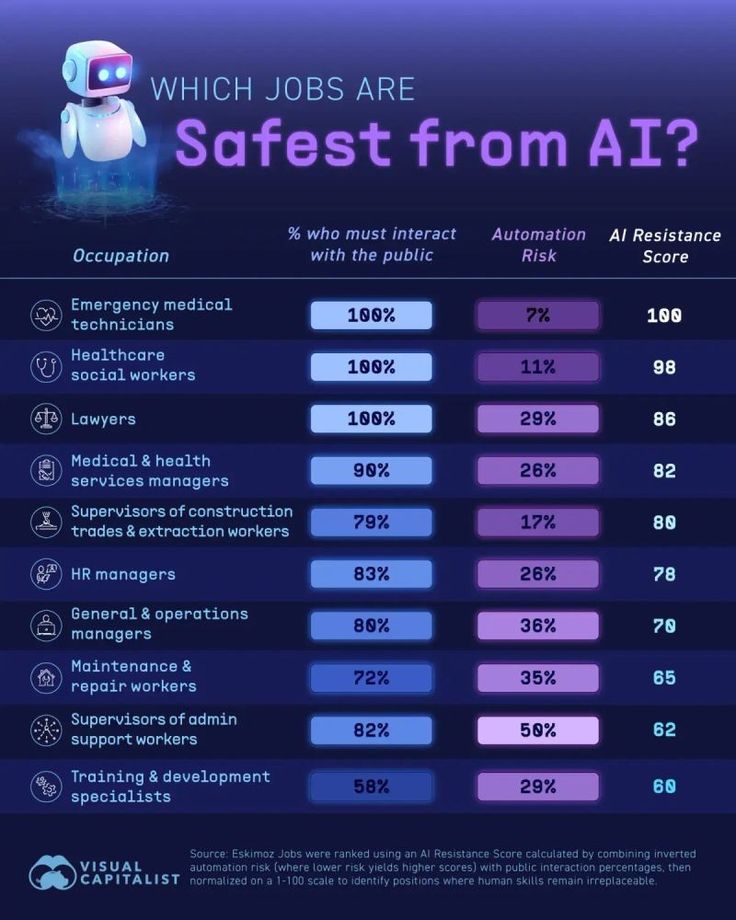
Which Careers Are Most Likely to Be Affected by AI?
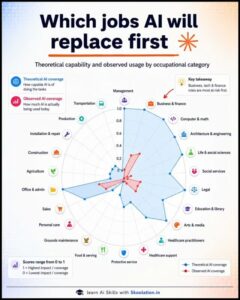
Artificial intelligence is changing the way people work across many industries. From writing and customer service to finance, healthcare, marketing, and technology, AI tools are increasingly being used to automate tasks, analyze information, and support decision-making.
This does not necessarily mean that AI will completely replace these careers. In many cases, AI is more likely to change the tasks workers perform and the skills employers look for.
Understanding which careers are most affected can help students, professionals, and job seekers prepare for changes in the workplace.
What Does It Mean for a Career to Be Affected by AI?
A career can be affected by AI in several ways.
AI may automate certain repetitive tasks, help workers complete tasks faster, or introduce new tools that change how a job is performed. In some professions, workers may spend less time on routine work and more time on activities that require creativity, communication, problem-solving, or human judgment.
Therefore, being “affected by AI” does not automatically mean that a profession will disappear. Instead, the responsibilities within that profession may change.
1. Data Entry and Administrative Work
Data entry is one area where automation can have a significant impact.
Many data-entry tasks involve entering, organizing, copying, or processing information. AI-powered software can perform some of these repetitive activities quickly.
Administrative professionals may also use AI to organize documents, summarize information, schedule activities, and handle routine communications.
This means workers in administrative roles may increasingly benefit from learning digital tools, data management, communication, and organizational skills.
2. Customer Service
Customer service is another field experiencing significant technological change.
AI-powered chatbots and virtual assistants can answer common questions, provide basic information, and help customers navigate simple problems.
However, complicated complaints and situations requiring empathy or judgment may still require human workers.
Customer service professionals can therefore strengthen their careers by developing communication, problem-solving, conflict-resolution, and relationship-building skills alongside their ability to use AI tools.
3. Content Writing
AI has had a major impact on content creation.
AI tools can generate drafts, summarize information, suggest headlines, create outlines, and help writers edit their work.
This can change the role of writers, but it does not eliminate the need for strong writing. Human writers are still important for original ideas, research, storytelling, personal experiences, expert analysis, and editorial judgment.
Writers who learn how to use AI responsibly may be able to spend more time on strategy, research, creativity, and improving the quality of their work.
4. Translation and Language Services
AI-powered translation systems have improved significantly and can quickly translate large amounts of text.
This may affect routine translation work, especially when the material is straightforward and does not require specialized knowledge.
However, professional translators may still be needed for legal, medical, technical, literary, and culturally sensitive content where accuracy and context are especially important.
Language professionals can adapt by developing specialized knowledge and learning how to review and edit machine-generated translations.
5. Marketing
Marketing professionals increasingly use AI for tasks such as analyzing customer data, generating content ideas, identifying trends, and creating advertising variations.
Some routine marketing activities can therefore become faster and more automated.
At the same time, marketing still requires creativity, strategy, understanding of audiences, brand development, and communication.
Professionals who combine marketing knowledge with data analysis and AI skills may be better prepared for workplaces where these technologies are widely used.
6. Accounting and Finance
AI can process large amounts of financial information and automate certain repetitive accounting tasks.
For example, software can assist with organizing transactions, detecting unusual patterns, preparing reports, and processing financial information.
Accountants and finance professionals may consequently spend more time on analysis, planning, compliance, consulting, and financial decision support.
Strong knowledge of accounting principles will remain important, while technology and data skills can become increasingly valuable.
7. Graphic Design
AI image-generation and design tools are changing parts of the creative industry.
Professionals can use AI to generate concepts, explore visual ideas, edit images, and create design variations.
This may affect some basic design tasks, particularly work that involves repetitive or highly standardized visuals.
However, professional design involves much more than producing an image. Understanding a client’s goals, developing a visual identity, communicating ideas, and making creative decisions remain important skills.
8. Software Development
Software development is also being influenced by AI.
AI coding assistants can help programmers write code, identify errors, explain programming concepts, and generate routine code.
This could reduce the amount of time developers spend on certain repetitive programming tasks.
However, software development also involves system design, architecture, security, testing, understanding user requirements, and solving complex problems.
Developers who learn to work effectively with AI coding tools may use them to increase productivity while continuing to apply their technical judgment.
9. Legal Support Roles
AI can process and analyze large volumes of legal documents, search for information, summarize text, and assist with document review.
These capabilities may affect some routine tasks performed by legal assistants and other support professionals.
However, legal work often involves interpretation, negotiation, ethical considerations, client relationships, and professional judgment.
AI may therefore change how legal professionals work without eliminating the need for human expertise.
10. Journalism and Media
AI is increasingly being used in media organizations for tasks such as summarizing information, analyzing data, generating basic drafts, and producing routine reports.
This can affect certain types of journalism, particularly repetitive content based on structured information.
However, investigative reporting, interviewing, source verification, editorial judgment, and original reporting require skills that go beyond automated text generation.
Journalists who understand AI while maintaining strong research and verification skills can adapt to changing media environments.
11. Banking and Financial Services
Banks and financial institutions already use technology to automate various processes.
AI can assist with fraud detection, customer support, risk analysis, document processing, and financial data analysis.
Some routine banking tasks may therefore become increasingly automated.
At the same time, financial institutions still need professionals who understand customers, regulations, risk, financial products, and complex decisions.
12. Transportation and Logistics
AI is also changing transportation and logistics.
Companies can use AI to optimize routes, predict demand, manage inventory, and improve delivery operations.
Automation could affect certain repetitive tasks within warehouses and transportation systems.
However, the overall industry still requires people to manage operations, maintain equipment, handle unexpected situations, and make decisions when automated systems encounter problems.
Which Skills Will Become More Important?
As AI changes different careers, workers can focus on skills that complement technology.
Some valuable areas include:
- Critical thinking
- Communication
- Creativity
- Problem-solving
- Leadership
- Emotional intelligence
- Data literacy
- Digital skills
- Industry-specific knowledge
- Adaptability
- AI literacy
Learning how to work with AI can also become an important professional skill.
How Can Workers Prepare for AI?
Workers do not necessarily need to become AI engineers to prepare for an AI-driven workplace.
A practical approach is to understand how AI is being used in your industry and identify which tasks may change.
You can then learn relevant AI tools and develop complementary human skills.
For example, a marketing professional might learn AI-assisted research and analytics. A writer could learn AI editing and research workflows. An accountant might develop stronger data-analysis skills.
Continuous learning can help professionals adapt as technology changes.
Final Thoughts
AI is likely to affect many careers, but its impact will not be identical across every profession.
Jobs involving repetitive, predictable, and information-processing tasks may experience more automation, while careers that depend heavily on human relationships, creativity, complex judgment, physical activity, or specialized expertise may change in different ways.
The important question is not simply whether AI will replace a particular career. It is also how AI will change the tasks within that career.
For students and professionals, developing adaptable skills, understanding new technologies, and continuing to learn can help them navigate an evolving job market. AI is becoming part of the workplace, and learning how to work alongside it may become an important part of many careers.