
Which AI Skills Are Employers Looking For?
Artificial intelligence is becoming an important part of the modern workplace. Companies in technology, finance, marketing, healthcare, education, retail, manufacturing, and many other industries are using AI tools to automate tasks, analyze information, improve productivity, and support business decisions.
As AI becomes more common, employers are increasingly interested in people who understand how to use these technologies effectively. However, you do not always need to be an AI engineer or computer scientist to develop valuable AI skills.
Many employers are looking for a combination of AI knowledge, digital skills, industry expertise, and human abilities.
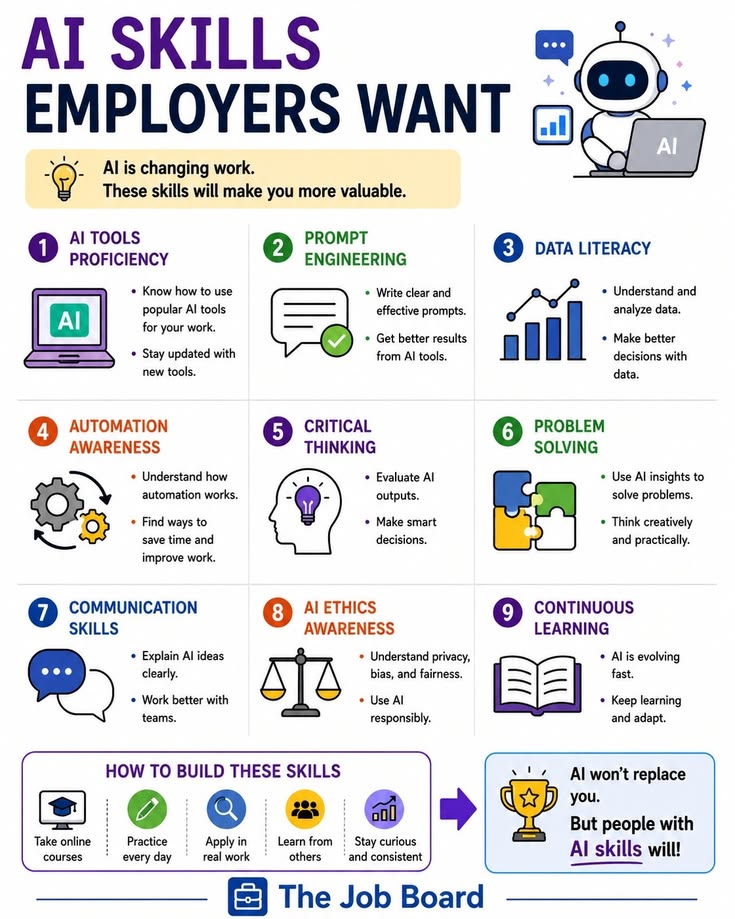
1. AI Literacy
One of the most useful skills for today’s workplace is basic AI literacy.
AI literacy means understanding what artificial intelligence can and cannot do, how common AI tools work at a basic level, and how they can be applied to workplace tasks.
Employees with AI literacy can identify opportunities to use AI while also recognizing its limitations.
For example, an employee might understand that AI can help summarize information but that important facts should still be checked before the information is used.
2. Prompt Writing
Prompt writing involves giving AI systems clear instructions to produce useful results.
A good prompt can include the task, context, desired format, audience, and specific requirements.
For example, instead of asking an AI tool to “write a report,” a worker could explain the topic, intended audience, length, tone, and information that should be included.
Learning how to communicate clearly with AI can help employees use AI tools more effectively.
3. Data Analysis
AI and data are closely connected.
Many organizations collect large amounts of information about customers, sales, operations, finances, and performance. Employees who can understand and analyze data can help businesses make better-informed decisions.
Useful data skills may include working with spreadsheets, databases, dashboards, statistics, and data visualization tools.
AI can assist with some parts of data analysis, but employees still need to understand what the data means and whether the results make sense.
4. Machine Learning Knowledge
Machine learning is a major area of artificial intelligence.
Employees working directly with AI systems may benefit from understanding concepts such as training data, algorithms, models, prediction, classification, and evaluation.
You do not necessarily need advanced machine-learning knowledge for every career. However, basic understanding can be valuable for people working in technology, data, research, product development, and other AI-related fields.
5. AI Tool Proficiency
Employers may also value people who know how to use AI-powered tools relevant to their industry.
For example, a marketing professional might use AI for research, content ideas, customer analysis, or campaign planning.
A programmer might use AI-assisted development tools.
A customer-service employee might work with AI-powered support systems.
The specific tools can change over time, so learning how to evaluate and adapt to new tools may be more valuable than becoming dependent on one particular platform.
6. Critical Thinking
AI can produce useful information, but it can also make mistakes.
This makes critical thinking extremely important.
Employees need to be able to question AI-generated information, identify inconsistencies, verify important facts, and decide whether an AI-generated result is appropriate for the situation.
Someone who simply accepts every AI response may create problems for an organization.
A worker who knows how to evaluate AI output can use the technology more responsibly.
7. Cybersecurity Awareness
As organizations adopt more AI systems, understanding cybersecurity becomes increasingly important.
Employees working with AI should understand basic concepts such as protecting sensitive information, recognizing security risks, and following organizational policies.
People working directly in cybersecurity may need much more advanced AI and security knowledge, but basic security awareness can benefit employees across many industries.
8. Automation Skills
AI can be used to automate repetitive workplace processes.
Employees who understand automation can identify tasks that can be simplified and create more efficient workflows.
For example, a business employee might automate parts of a reporting process instead of manually repeating the same steps every week.
Learning about workflow automation can therefore be useful for professionals in administration, marketing, sales, finance, operations, and technology.
9. Communication Skills
Technical AI knowledge is only one part of being successful in an AI-powered workplace.
Communication remains extremely important.
Professionals need to explain ideas, discuss problems with colleagues, communicate with customers, and present information clearly.
Even when AI performs part of a task, humans often need to explain the results and decide what action should be taken.
Strong written and verbal communication can therefore complement technical AI skills.
10. Problem-Solving
Employers value people who can identify problems and find practical solutions.
AI can provide suggestions, analyze information, and automate certain tasks, but workers still need to understand the underlying problem.
For example, if a company is losing customers, an employee needs to investigate why that is happening and determine which information is relevant.
AI may assist with the analysis, but human problem-solving remains important.
11. AI Ethics and Responsible AI Use
Understanding responsible AI use is becoming increasingly important.
AI systems can create inaccurate information, reflect biases in data, or raise privacy and security concerns.
Employees should understand the importance of checking AI-generated information, protecting confidential data, and following company policies.
Professionals working with sensitive information may need a deeper understanding of privacy, fairness, transparency, and responsible AI practices.
12. Adaptability and Continuous Learning
AI technology changes quickly.
A tool that is widely used today may be replaced or significantly changed in the future. Because of this, employers may value workers who are comfortable learning new technologies.
Adaptability means being willing to develop new skills, experiment with unfamiliar tools, and adjust to changing workplace processes.
Continuous learning can help professionals remain useful as technology evolves.
Do You Need to Learn Coding to Build AI Skills?
Not necessarily.
Coding is important for careers such as software engineering, machine learning engineering, AI research, and some data-science roles.
However, many professionals can benefit from AI without becoming programmers.
Marketing specialists, writers, teachers, designers, business professionals, accountants, managers, and other workers can learn how AI applies to their fields.
The most useful skills will depend on the career you want to pursue.
How Can You Start Building AI Skills?
You can begin with basic AI literacy and gradually develop more advanced abilities.
A simple learning path could look like this:
Step 1: Learn the basics of artificial intelligence.
Step 2: Experiment with AI tools relevant to your career.
Step 3: Practice writing clear prompts.
Step 4: Learn how to check and verify AI-generated information.
Step 5: Develop data and digital skills.
Step 6: Learn about responsible and secure AI use.
Step 7: Create small projects that demonstrate your skills.
Step 8: Continue learning as AI technology develops.
Building practical projects can also help demonstrate what you can actually do with AI rather than simply listing “AI skills” on a resume.
Final Thoughts
AI skills are becoming increasingly relevant across many types of careers. Employers may look for different combinations of technical knowledge, AI tool experience, data skills, problem-solving ability, communication, and adaptability depending on the role.
You do not have to master every area of artificial intelligence. Instead, focus on the AI skills that are most relevant to your career goals.
Learning how to use AI effectively while maintaining strong human skills can help professionals adapt to changing workplaces and prepare for new opportunities.
As AI continues to develop, employers will need workers who can combine technology skills with creativity, communication, and good judgment. Learning these skills now can help you adapt to future career opportunities.