
What Jobs Require AI Skills?
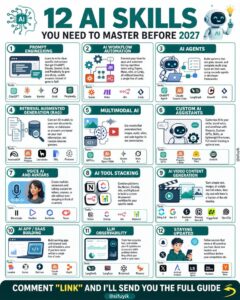
Artificial intelligence is becoming an increasingly important part of the modern workplace. Companies across technology, finance, healthcare, marketing, education, retail, manufacturing, and other industries are using AI to improve processes, analyze information, automate tasks, and develop new products and services.
As a result, AI skills are becoming useful across a wide range of careers. Some jobs require advanced knowledge of machine learning and programming, while others simply require professionals to understand how to use AI tools effectively.
This means you do not necessarily need to become an AI engineer to benefit from learning artificial intelligence skills. The important question is which AI skills are relevant to the career you want to pursue.
1. AI Engineers
AI engineering is one of the most technical career paths involving artificial intelligence.
AI engineers may design, develop, test, and maintain AI-powered systems. Their work can involve machine learning models, data processing, software development, and AI applications.
Skills commonly associated with this type of work include programming, mathematics, machine learning, data structures, software development, and knowledge of AI frameworks.
People interested in this career generally need a strong technical foundation.
2. Machine Learning Engineers
Machine learning engineers focus on developing and deploying systems that learn from data.
Their work can involve preparing datasets, training models, evaluating performance, improving systems, and integrating machine learning models into applications.
Programming and statistical knowledge are particularly useful in this field.
Machine learning engineers also need to understand how to test models and identify problems with their performance.
3. Data Scientists
Data scientists use data to help organizations understand problems and make informed decisions.
AI and machine learning can be important parts of their work.
Data scientists may use statistical methods, programming, data visualization, and machine learning to identify patterns and develop predictive models.
Professionals interested in this career should consider learning tools such as Python, SQL, statistics, and data-analysis techniques.
4. Software Developers
Software developers are increasingly working alongside AI tools.
Developers may use AI-assisted coding systems to generate code, explain programming concepts, identify potential errors, and improve development workflows.
Some developers also build applications that incorporate AI capabilities.
Understanding AI can therefore be useful even for developers whose primary responsibility is general software development.
5. Data Analysts
Data analysts work with information to identify patterns and provide insights.
AI can help analysts process information, identify trends, generate summaries, and support certain analytical tasks.
A data analyst may benefit from learning spreadsheets, SQL, data visualization, statistics, and AI-assisted analytical tools.
The ability to evaluate AI-generated results is also important because automated analysis can contain errors.
6. Cybersecurity Professionals
Cybersecurity is another area where AI skills can be useful.
Security professionals may use AI-assisted tools to identify unusual activity, analyze large amounts of information, detect potential threats, and support security operations.
At the same time, cybersecurity professionals need to understand how AI itself can introduce new security challenges.
Knowledge of cybersecurity fundamentals remains essential.
7. Digital Marketers
Marketing professionals are increasingly using AI for research, content development, customer analysis, personalization, and campaign planning.
Digital marketers can use AI to brainstorm content ideas, analyze marketing data, organize customer information, and support advertising strategies.
Important skills can include digital marketing, analytics, content strategy, SEO, communication, and AI-assisted marketing tools.
AI knowledge can complement rather than replace marketing expertise.
8. Content Writers
Writers can use AI tools to support research, brainstorming, outlining, editing, and content development.
However, professional writing still requires strong communication skills, originality, accuracy, and an understanding of the intended audience.
Writers who understand how to use AI responsibly may be able to improve parts of their workflow while maintaining human oversight over the final content.
9. Graphic Designers
AI-assisted creative tools are becoming increasingly common in design workflows.
Graphic designers may use AI for brainstorming concepts, generating visual ideas, editing images, creating variations, or speeding up repetitive tasks.
Design fundamentals such as composition, typography, visual communication, and branding remain important.
The ability to combine design expertise with new AI tools can help designers adapt to changing workflows.
10. Product Managers
Product managers help organizations decide what products or features to build and how those products should serve customers.
As more companies develop AI-powered products, product managers may need to understand AI concepts, data requirements, user experience considerations, and the limitations of AI systems.
They do not necessarily need to become programmers, but AI literacy can help them communicate effectively with technical teams and make informed product decisions.
11. Business Analysts
Business analysts examine business processes and identify opportunities for improvement.
AI can support their work by analyzing information, identifying patterns, and helping organizations explore automation opportunities.
Business analysts can benefit from understanding both business operations and the practical capabilities and limitations of AI.
12. Human Resources Professionals
AI is increasingly being discussed and used in areas such as recruitment, employee support, workforce analytics, and administrative processes.
HR professionals may use AI tools to organize information, draft communications, analyze workforce data, or automate certain administrative tasks.
However, AI use in employment-related decisions requires careful consideration of privacy, fairness, accuracy, and organizational policies.
Human judgment remains important.
13. Financial Professionals
AI can support various financial activities, including data analysis, forecasting, fraud detection, customer service, and process automation.
Accountants, financial analysts, banking professionals, and other finance workers may benefit from learning how AI can support their existing responsibilities.
Financial professionals should also understand the risks of relying on automated outputs, particularly when decisions involve significant financial consequences.
14. Healthcare Professionals
AI is being explored and used across many areas of healthcare, including medical research, administrative work, imaging, data analysis, and patient-support technologies.
Healthcare professionals do not necessarily need to become AI developers, but understanding AI’s capabilities and limitations can help them work effectively with AI-enabled systems.
Healthcare applications also require careful attention to privacy, safety, accuracy, and professional standards.
15. Customer Service Professionals
AI-powered customer service systems can assist with frequently asked questions, information retrieval, and routine interactions.
Customer service professionals may therefore benefit from learning how to work alongside AI systems.
Human representatives remain important for complex situations that require empathy, judgment, negotiation, or specialized assistance.
16. Project Managers
Project managers can use AI to organize information, summarize meetings, create task lists, analyze project data, and support planning.
AI skills can help project managers understand where automation may improve workflows.
However, project management still depends heavily on communication, leadership, coordination, and decision-making.
17. Teachers and Education Professionals
Educators can use AI to support lesson planning, brainstorming, personalized learning activities, administrative tasks, and educational content development.
Teachers who understand AI can also help students develop responsible technology skills.
However, educators need to evaluate AI-generated educational content carefully and follow their institution’s policies.
18. Entrepreneurs and Small Business Owners
AI skills can also be valuable for people who run businesses.
Entrepreneurs may use AI for market research, customer communication, marketing, content creation, data analysis, administrative tasks, and workflow automation.
Business owners do not necessarily need technical AI expertise. Understanding how to identify useful AI applications can itself be valuable.
What AI Skills Are Most Useful?
The AI skills you need depend on your career.
Some professionals may benefit from basic AI literacy and prompt writing. Others may need advanced programming, machine learning, statistics, data analysis, automation, or AI system development.
Useful skills across many careers include:
- AI literacy
- Prompt writing
- Critical thinking
- Data analysis
- Automation
- AI-assisted research
- AI-assisted writing
- Responsible AI use
- Problem-solving
- Continuous learning
Combining AI skills with professional expertise is often more useful than learning AI in isolation.
Final Thoughts
AI skills are becoming relevant to many different careers. Technical roles such as AI engineering, machine learning, data science, and software development may require advanced technical knowledge, while careers in marketing, finance, education, design, human resources, customer service, and project management can benefit from practical AI literacy.
You do not need to learn every AI technology. Start by identifying the AI skills that are relevant to your career goals.
Learn how AI can support your work, understand its limitations, practice using appropriate tools, and continue developing your professional expertise.
The future of work is not simply about knowing how to use AI. It is about combining AI capabilities with human knowledge, judgment, creativity, communication, and problem-solving.