
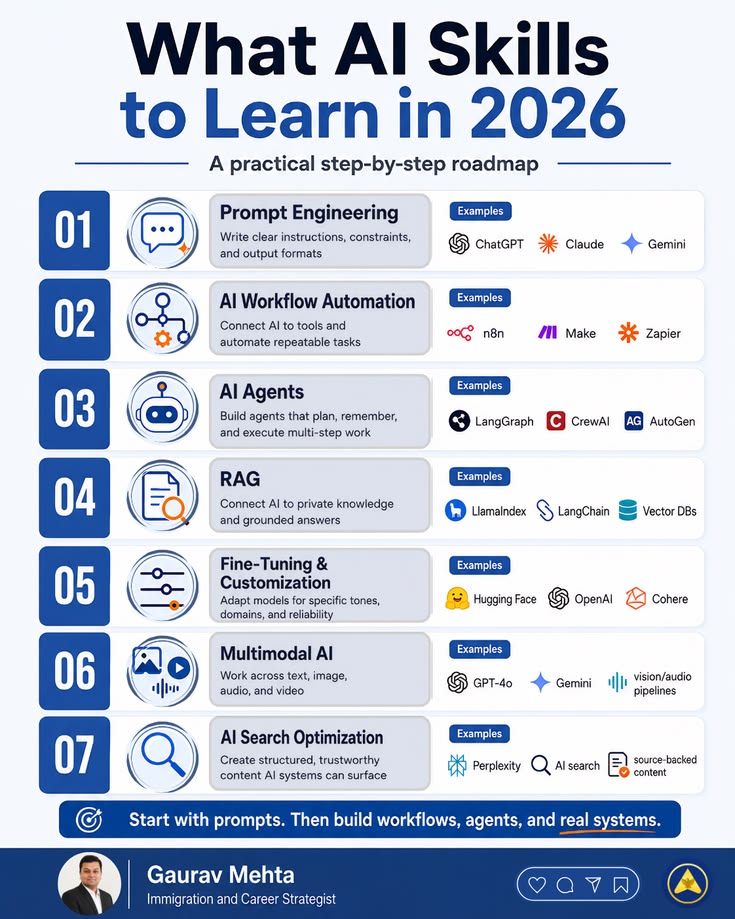
What AI Skills Should You Learn for Your Career?

Artificial intelligence is becoming an important part of the modern workplace. Companies are using AI to analyze information, automate repetitive tasks, improve customer experiences, create content, support employees, and develop new products and services.
As AI becomes more common, workers and job seekers are increasingly interested in learning AI skills that can support their careers. You do not necessarily need to become a programmer or AI engineer to benefit from artificial intelligence. Many AI skills can be useful in everyday professional roles.
The right skills depend on your career goals, industry, and existing experience. However, developing a combination of AI knowledge, technical abilities, and human skills can help you adapt to an evolving workplace.
1. AI Literacy
One of the first skills professionals should develop is basic AI literacy.
AI literacy means understanding what artificial intelligence is, what it can do, and where its limitations are.
You should understand basic concepts such as machine learning, generative AI, large language models, automation, and AI-assisted applications.
You should also understand that AI systems can sometimes produce incorrect information.
You do not need advanced mathematics or programming to develop basic AI literacy. The goal is to understand how AI can be used responsibly in your profession.
2. Prompt Writing
Prompt writing is the ability to give AI systems clear instructions.
A vague request may produce a general answer, while a detailed prompt can provide more useful results.
For example, instead of asking an AI tool to “write an email,” you can explain the purpose of the email, the audience, the tone, the important information, and the desired length.
Learning how to provide useful context and clear instructions can improve your ability to work with AI tools.
3. AI-Assisted Research
AI can help professionals organize research, summarize information, generate questions, and identify areas that require further investigation.
Learning how to use AI for research can save time.
However, an important part of this skill is verification. AI-generated information should not automatically be treated as accurate.
Professionals should learn how to check important claims against reliable sources before using them.
4. Data Analysis
Data skills are becoming increasingly valuable across many industries.
AI can assist with analyzing datasets, identifying patterns, generating summaries, and creating insights.
Learning basic data analysis can help you understand how to work with information more effectively.
You can start with spreadsheets and gradually learn tools such as SQL, Python, or data visualization platforms depending on your career goals.
You do not have to become a data scientist to benefit from understanding data.
5. Automation Skills
AI can help automate repetitive workflows.
Learning basic automation concepts can help professionals identify tasks that can be completed more efficiently.
For example, you might automate parts of a reporting process, organize information automatically, or connect different software tools.
You do not necessarily need advanced programming skills. Many modern automation platforms provide visual tools that allow users to create workflows without writing large amounts of code.
6. Generative AI Skills
Generative AI can create text, images, code, audio, and other forms of content.
Learning how to use these tools effectively can be useful in many careers.
A marketer might use generative AI for brainstorming and content development. A designer may use AI-assisted creative tools. A programmer may use AI to help understand or generate code.
The important skill is knowing how to use these systems while reviewing their output carefully.
7. AI-Assisted Writing
Communication is important in almost every career.
AI can help professionals create drafts, improve grammar, organize ideas, summarize information, and adjust tone.
Learning how to use AI for writing can make routine communication more efficient.
However, professionals should still review AI-generated writing to ensure that it accurately represents their ideas and sounds natural.
8. AI-Assisted Coding
If you work in technology or want to enter software development, AI-assisted coding can be a valuable skill.
AI coding tools can help programmers generate code, explain unfamiliar code, identify potential errors, and create initial solutions.
However, developers still need to understand programming fundamentals.
You should be able to review AI-generated code, identify problems, test it, and make appropriate changes.
Using AI without understanding the underlying code can create security and reliability problems.
9. Machine Learning Fundamentals
People interested in technical AI careers should consider learning machine learning.
Important concepts include:
- Supervised learning
- Unsupervised learning
- Classification
- Regression
- Model training
- Model evaluation
- Features
- Overfitting
- Neural networks
You can begin with beginner-friendly courses and practical projects.
Understanding the fundamentals is more important than trying to memorize every machine learning algorithm.
10. AI Ethics and Responsible AI
Technical skills are not enough.
Professionals should understand the ethical and practical risks associated with AI.
These can include privacy concerns, bias, misinformation, security risks, intellectual property issues, and inappropriate use of automated decisions.
Learning responsible AI practices can help you use technology more carefully in the workplace.
This is particularly important when working with customer information, employee data, financial information, or other sensitive material.
11. Critical Thinking
Critical thinking may be one of the most important skills to develop alongside AI.
AI can produce convincing answers that are not necessarily correct.
Professionals need to evaluate information, question assumptions, compare sources, and identify potential errors.
Instead of asking only, “Can AI give me an answer?” ask, “How reliable is this answer, and what evidence supports it?”
This mindset can help you use AI more effectively.
12. AI Workflow Design
Another valuable skill is understanding how AI can fit into an entire workflow.
Instead of using AI for one isolated task, you can identify several steps where it might assist.
For example, a marketing workflow might involve research, idea generation, content drafting, editing, scheduling, and performance analysis.
AI could potentially assist with several of these stages while humans remain responsible for strategy and quality control.
Understanding workflows can help professionals find practical applications for AI.
13. Industry-Specific AI Skills
AI skills become even more valuable when combined with knowledge of a specific industry.
A healthcare professional may need to understand AI applications in healthcare. A marketer can learn AI-powered marketing tools. A financial professional can explore AI-assisted financial analysis.
You do not have to learn every AI technology.
Instead, focus on how artificial intelligence is being applied to your particular field.
14. Communication and Collaboration
AI skills should be combined with strong human skills.
Communication, teamwork, leadership, creativity, empathy, and problem-solving remain important in professional environments.
AI can provide information and suggestions, but people still need to communicate decisions, work with colleagues, understand customers, and manage relationships.
Developing these skills alongside AI knowledge can make you more adaptable.
15. Continuous Learning
AI technology changes quickly.
New tools, models, features, and applications appear regularly. As a result, learning how to learn may be just as important as mastering one specific AI tool.
Follow developments relevant to your profession, experiment with useful technologies, take courses, and work on practical projects.
You do not need to learn every new AI product. Focus on technologies that provide genuine value for your career.
How Should You Start Learning AI Skills?
You do not need to learn everything at once.
Start by identifying your career goal.
If you work in marketing, begin with AI-assisted content, research, analytics, and automation.
If you want to become a software developer, focus on programming, AI-assisted coding, data structures, and machine learning fundamentals.
If you work in administration, explore AI-assisted writing, document management, research, and workflow automation.
The best learning path is one connected to the work you want to do.
Final Thoughts
The AI skills you should learn depend on your career, but several skills can benefit professionals across different industries. AI literacy, prompt writing, research, data analysis, automation, generative AI, critical thinking, responsible AI, and continuous learning are useful foundations.
For technical careers, you can go further by learning programming, machine learning, data science, and AI engineering.
The goal is not simply to collect AI skills. It is to learn how to apply them to real problems.