Can AI Help You Get Hired Faster?
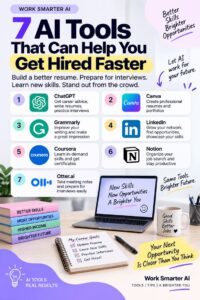
Finding a job can take time. Job seekers often need to search through job listings, customize resumes, write cover letters, complete applications, prepare for interviews, and follow up with employers. For people applying to multiple positions, managing the entire process can become difficult.
Artificial intelligence can help simplify some of these tasks. From improving resumes and preparing for interviews to organizing job searches and identifying skills employers are looking for, AI can become a useful assistant during the hiring process.
However, AI does not guarantee employment. Getting hired still depends on your qualifications, experience, skills, communication, the requirements of the position, and the decisions of employers. The value of AI comes from helping you prepare more efficiently and present your genuine qualifications more clearly.
1. Use AI to Improve Your Resume
One of the first ways AI can help with a job search is by reviewing your resume.
You can use an AI tool to identify unclear descriptions, repetitive language, grammatical problems, or sections that could be presented more effectively.
For example, instead of simply listing your responsibilities, AI can help you describe actual accomplishments in a clearer and more professional way.
However, your resume should always contain truthful information. Do not allow AI to invent qualifications, job experience, certifications, or achievements.
2. Customize Your Resume for Different Jobs
Sending exactly the same resume to every employer may not always communicate how your experience relates to each position.
AI can help you compare your existing skills and experience with the requirements of a particular job description.
For example, if a job emphasizes customer communication, project management, data analysis, and teamwork, AI can help you identify where your genuine experience demonstrates those abilities.
You can then adjust your resume to emphasize relevant experience without misrepresenting your background.
3. Write Better Cover Letters
Writing a different cover letter for every application can be time-consuming.
AI can help create a first draft based on your actual experience and the requirements of a particular position.
You can then edit the draft to make it personal and specific.
A good cover letter should explain why you are interested in the position and how your real skills and experience relate to the role. Avoid submitting generic AI-generated text without reviewing it.
4. Find Relevant Job Opportunities
AI can also help organize your job search.
You can use AI to identify job titles related to your skills and experience or generate alternative keywords to use when searching job boards.
For example, someone interested in digital marketing might search for roles such as marketing assistant, content specialist, SEO specialist, social media coordinator, or digital marketing associate.
Understanding different job titles can help you discover opportunities that you might otherwise overlook.
5. Analyze Job Descriptions
Job descriptions can sometimes contain a long list of responsibilities and requirements.
AI can help break the information into categories, such as required skills, preferred qualifications, responsibilities, and experience levels.
This can make it easier to determine whether your background matches the position.
AI can also help you identify skills that you may need to strengthen before applying for similar positions in the future.
6. Prepare for Interviews
Interview preparation is another area where AI can be useful.
You can provide the general details of a position and ask AI to generate practice questions.
For example, an applicant for an entry-level technology role might practice questions about problem-solving, teamwork, technical knowledge, and previous projects.
You can also practice behavioral questions using the STAR approach: Situation, Task, Action, and Result.
The purpose is not to memorize AI-generated answers. Instead, use the questions to practice explaining your own experiences confidently.
7. Practice Difficult Interview Questions
Some interview questions can be challenging, especially for people with limited experience.
AI can help you practice questions such as:
- Why should we hire you?
- What are your strengths?
- What is an area you are working to improve?
- Why are you interested in this position?
- Tell us about a difficult problem you solved.
- Where do you see your career developing?
You can create your own answers and then ask AI for feedback on clarity and structure.
This can help you become more comfortable before the actual interview.
8. Improve Professional Communication
Job searching involves communication with recruiters and employers.
AI can help you review professional emails, interview thank-you messages, networking messages, and follow-up communications.
For example, after an interview, you can use AI to help organize a short thank-you message while ensuring that the final version sounds natural and reflects your own voice.
Clear and professional communication can help you make a positive impression.
9. Identify Skills You Need to Develop
AI can help you compare your current abilities with the requirements of jobs you are interested in.
Suppose you want to become a data analyst but many job descriptions mention SQL, spreadsheets, data visualization, and statistics.
You can use this information to create a learning plan.
Instead of applying randomly, you can focus on developing skills that are genuinely relevant to your career goals.
10. Build a Stronger Portfolio
For many careers, a portfolio can provide evidence of practical ability.
AI can help you brainstorm project ideas and organize your work.
For example, an aspiring marketer could create a sample marketing campaign. A beginner programmer could build a small application. A data analyst could analyze a public dataset and present the findings.
AI can assist with parts of these projects, but the final work should accurately represent your abilities.
11. Prepare for Technical Assessments
Some employers use tests or practical assessments during the hiring process.
AI can help you study for these assessments by generating practice problems and explaining concepts you find difficult.
For technical careers, you might use AI to practice programming problems. For analytical roles, you could practice data interpretation or logical reasoning.
Always check the rules of an employer’s assessment. Some organizations may prohibit the use of AI during tests or interviews.
12. Organize Your Job Search
Applying for multiple positions can become difficult to manage.
You can use AI to help create a structured job-search plan.
For example, you could organize applications according to:
- Company
- Position
- Application date
- Deadline
- Interview stage
- Follow-up date
- Required documents
Keeping track of this information can reduce confusion and help you stay organized.
13. Use AI for Career Research
If you are unsure about which positions to apply for, AI can help you explore different career paths.
You can describe your education, experience, interests, and skills and ask for possible job categories to research.
However, treat AI suggestions as a starting point. Verify salary information, qualifications, job requirements, and career outlook using reliable sources.
14. Avoid Common AI Job-Search Mistakes
Although AI can be helpful, using it incorrectly can hurt your application.
Avoid submitting resumes filled with generic phrases that do not reflect your experience.
Do not copy an AI-generated cover letter without reviewing it.
Do not use AI to exaggerate your qualifications.
You should also carefully check AI-generated information because it can sometimes produce incorrect or outdated answers.
The goal is to use AI as an assistant, not as a substitute for your own judgment.
15. Combine AI With Human Effort
The most effective job search is likely to involve both technology and personal effort.
AI can help you prepare documents and practice interviews, but you still need to research employers, build professional relationships, demonstrate your skills, communicate with recruiters, and perform well during interviews.
Human connections remain an important part of many career opportunities.