
What Are the Most Valuable AI Skills to Learn?
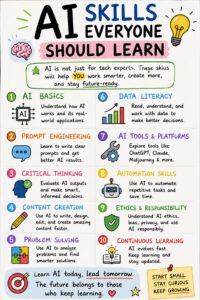
Artificial intelligence is becoming an important part of the modern workplace. Businesses are using AI to automate tasks, analyze data, improve customer experiences, create content, develop software, and support decision-making.
As AI adoption grows, learning useful AI skills can help students, job seekers, freelancers, and working professionals prepare for changing career opportunities.
However, there is no single AI skill that is valuable for everyone. The right skills depend on your career goals. A software developer may need programming and machine learning, while a marketer may benefit more from AI-assisted content creation, data analysis, and automation.
The following are some of the most valuable AI skills to consider learning.
1. AI Literacy
AI literacy is a useful starting point for almost everyone.
It means understanding basic AI concepts, how AI systems are used, what they can do, and where their limitations are.
You should understand terms such as artificial intelligence, machine learning, generative AI, large language models, automation, and data.
AI literacy can help you make better decisions about when and how to use AI at work.
2. Prompt Engineering
Prompt engineering involves creating clear and effective instructions for AI systems.
A well-structured prompt can provide context, explain the objective, identify the desired format, and establish important requirements.
For example, instead of simply asking an AI tool to “write an article,” you could explain the target audience, topic, tone, structure, word count, and information that should be included.
Good prompting is useful for writing, research, brainstorming, coding, analysis, and many other tasks.
3. AI-Assisted Research
AI can help people find, organize, summarize, and explore information.
Learning how to use AI for research can improve productivity, but it is equally important to verify important information.
AI systems can sometimes provide incorrect or outdated answers.
Therefore, a valuable research skill is knowing how to combine AI assistance with reliable sources and human judgment.
4. Data Analysis
AI and data are closely connected.
Learning how to work with data can provide useful career opportunities across technology, finance, marketing, healthcare, business, and other industries.
Basic data skills include spreadsheets, data visualization, statistics, and interpreting datasets.
People pursuing technical careers can go further by learning SQL, Python, databases, and machine learning techniques.
5. Python Programming
Python is an important programming language for many AI and data-related applications.
If you want to pursue a technical AI career, learning Python can provide a strong foundation.
Start with basic concepts such as variables, functions, loops, conditions, data structures, and file handling.
After developing programming fundamentals, you can explore libraries and frameworks used for data analysis and machine learning.
6. Machine Learning
Machine learning is one of the core areas of artificial intelligence.
It involves developing systems that can identify patterns in data and use those patterns to make predictions or decisions.
Students and professionals interested in technical AI careers can learn about supervised learning, unsupervised learning, model evaluation, training data, and common machine-learning algorithms.
Machine learning requires more technical knowledge than basic AI tool usage, so it is usually best learned after developing programming and mathematical foundations.
7. Generative AI
Generative AI can produce content such as text, images, audio, video, and computer code.
Understanding how generative AI works and how it can be applied to professional tasks can be valuable across many careers.
Professionals can learn how to use generative AI for brainstorming, drafting, research support, content development, coding assistance, and workflow improvement.
The key is learning how to use it responsibly and evaluate its output.
8. AI Automation
Automation is another valuable AI-related skill.
Workers can learn how to identify repetitive tasks and connect software tools to create automated workflows.
For example, an automated system could collect information, organize it, generate a report, and notify a team member when the process is complete.
Automation skills can be useful in business operations, marketing, administration, customer service, and technology.
9. AI-Assisted Coding
AI is increasingly being integrated into software-development workflows.
Developers can use AI tools to generate code, explain unfamiliar concepts, suggest solutions, identify potential errors, and assist with documentation.
However, developers still need strong programming fundamentals.
AI-generated code should be reviewed, tested, and understood before being used in important applications.
Learning how to collaborate with AI coding tools can therefore complement traditional programming skills.
10. Natural Language Processing
Natural language processing, or NLP, is a branch of AI focused on how computers process and understand human language.
NLP is used in chatbots, translation systems, search engines, text analysis, voice assistants, and many other applications.
People interested in technical AI careers can explore topics such as text classification, language models, sentiment analysis, speech recognition, and information extraction.
11. Computer Vision
Computer vision focuses on enabling computers to analyze and interpret visual information.
Applications include image recognition, object detection, medical imaging, manufacturing systems, security technologies, and autonomous systems.
Students interested in computer vision can learn about image processing, neural networks, datasets, and computer-vision models.
12. AI Ethics and Responsible AI
Technical ability is only one part of working with AI.
Professionals should also understand responsible AI.
Important areas include privacy, security, bias, transparency, misinformation, intellectual property, and human oversight.
Understanding these issues can help professionals recognize risks and use AI appropriately.
13. Critical Thinking
Critical thinking is one of the most important skills to develop alongside AI.
AI systems can produce answers that appear convincing but contain errors.
Professionals need to evaluate AI-generated information, check important claims, identify assumptions, and determine whether a recommendation makes sense.
Critical thinking helps people use AI as a tool without blindly accepting its output.
14. AI-Powered Data Visualization
Data visualization involves presenting information through charts, graphs, dashboards, and other visual formats.
AI can assist with identifying patterns and generating analytical insights.
Learning how to communicate data visually can help professionals explain complex information to colleagues, managers, and customers.
15. AI Product Management
AI product management combines knowledge of AI with business and product-development skills.
AI product managers may help identify customer problems, define product requirements, coordinate technical teams, evaluate AI capabilities, and consider risks.
This career path can be suitable for people who enjoy technology but also have strong business and communication interests.
16. AI Communication Skills
Knowing how to communicate about AI is increasingly useful.
Professionals may need to explain AI systems to customers, managers, employees, or other departments.
Being able to explain technical concepts in simple language can help organizations adopt AI more effectively.
Strong writing, presentations, teamwork, and communication can therefore complement technical AI knowledge.
17. Industry-Specific AI Knowledge
One of the most useful approaches is combining AI with knowledge of a specific industry.
For example:
- AI + finance
- AI + healthcare
- AI + marketing
- AI + education
- AI + cybersecurity
- AI + manufacturing
- AI + law
- AI + retail
Industry knowledge helps professionals understand where AI can actually solve useful problems.
How Should You Choose Which AI Skills to Learn?
Start with your career goal.
If you want to become an AI engineer, focus on programming, mathematics, data structures, machine learning, and AI frameworks.
If you want to work in marketing, consider AI-assisted content creation, analytics, research, automation, and digital marketing.
If you are a business professional, focus on AI literacy, automation, data analysis, communication, and problem-solving.
If you are a student, begin with AI fundamentals, basic programming, data skills, and practical projects.
You do not need to learn everything at once.
Build Projects While You Learn
Practical projects can help turn AI knowledge into usable skills.
For example, you could build a chatbot, create a data-analysis project, automate a repetitive task, develop a simple machine-learning application, or create an AI-assisted marketing workflow.
Document what you built, which tools you used, what problem you solved, and what you learned.
A portfolio can help demonstrate your abilities to potential employers or clients.
Final Thoughts
The most valuable AI skills depend on the career you want to build.
AI literacy, prompt writing, data analysis, automation, programming, machine learning, generative AI, critical thinking, and responsible AI use can all provide useful foundations.
The strongest approach is not simply to collect AI tools. Instead, combine AI skills with professional expertise and human abilities such as communication, creativity, problem-solving, and judgment.
AI technology will continue to change, so continuous learning is important. Start with the skills most relevant to your career, practice them through real projects, and gradually expand your knowledge as your goals develop.