
What Does an AI-Powered Workplace Look Like?
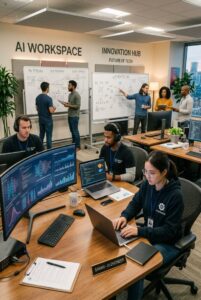
Artificial intelligence is changing how businesses operate and how employees complete their daily work. From automated customer service to AI-assisted research and data analysis, companies are increasingly using artificial intelligence to support employees and improve business processes.
An AI-powered workplace does not necessarily mean a company where robots replace human workers. Instead, it is an environment where employees use AI tools alongside traditional software and human expertise to complete tasks more efficiently.
The way an AI-powered workplace looks will vary from one organization to another. A technology company may use AI for software development and machine learning, while a marketing company may use it for content creation and customer analysis. Understanding these changes can help workers prepare for the future of work.
1. AI-Assisted Employees
One of the most noticeable features of an AI-powered workplace is employees working alongside AI tools.
AI can assist workers with tasks such as writing, research, analysis, brainstorming, scheduling, and information management.
For example, an employee preparing a report might use AI to organize information and create an initial summary. The employee can then review the information, correct mistakes, and add professional judgment.
In this environment, AI acts as an assistant rather than the final decision-maker.
2. Automated Repetitive Tasks
Many workplaces contain repetitive tasks that take employees significant amounts of time.
AI and automation can help handle certain routine activities, such as organizing documents, processing information, responding to common questions, scheduling tasks, or generating basic reports.
Reducing repetitive work can allow employees to spend more time on responsibilities that require creativity, communication, and decision-making.
However, automation needs to be properly designed and monitored to prevent errors.
3. AI-Powered Customer Service
Customer service is another area where AI can play an important role.
Businesses may use AI chatbots or virtual assistants to answer frequently asked questions, provide basic information, or direct customers to appropriate resources.
Human employees can then handle more complicated situations that require judgment, empathy, negotiation, or specialized knowledge.
This creates a workplace where AI handles some routine interactions while human representatives focus on more complex customer needs.
4. Data-Driven Decision-Making
AI-powered workplaces often make greater use of data.
AI systems can process large amounts of information and identify patterns that may be difficult to detect manually.
For example, businesses might use AI to analyze customer behavior, sales information, website activity, or operational data.
Managers can use these insights as one source of information when making decisions.
However, AI-generated analysis should be reviewed carefully because automated systems can produce inaccurate or misleading results.
5. AI-Assisted Recruitment
Human resources departments may use AI-supported systems for certain recruitment tasks.
For example, technology can help organize applications, identify information in resumes, schedule interviews, or support communication with candidates.
However, hiring decisions can have significant consequences. Organizations need appropriate human oversight and should consider issues such as fairness, privacy, accuracy, and applicable employment requirements.
AI should not automatically be treated as a substitute for responsible human decision-making.
6. Personalized Employee Training
AI can also support workplace learning.
Employees may use AI-powered learning systems to receive explanations, practice exercises, recommendations, and educational resources based on their roles or learning needs.
For example, a new employee could use an AI learning assistant to understand internal processes or practice using workplace software.
Human instructors and managers can continue to provide guidance, feedback, and context.
7. AI in Marketing
Marketing teams are already using AI for many activities.
AI can help marketers brainstorm campaigns, analyze customer data, research topics, generate content drafts, and identify patterns in marketing performance.
However, human marketers remain responsible for understanding the brand, audience, business objectives, and ethical considerations.
AI can speed up parts of the process without replacing the need for marketing strategy.
8. AI in Software Development
Software development is another area where AI can change daily workflows.
Developers may use AI-assisted coding tools to generate code, explain unfamiliar programming concepts, identify potential errors, or create initial solutions.
Developers still need to understand programming fundamentals and review the code carefully.
Testing, security checks, debugging, and human judgment remain important parts of software development.
9. AI-Powered Workplace Communication
AI can also assist with communication.
Employees may use AI to summarize meetings, organize notes, draft emails, translate information, or turn long documents into shorter summaries.
This can help employees manage large amounts of information.
However, sensitive information should only be entered into AI systems when the organization’s policies and security requirements permit it.
10. Smarter Project Management
Project management can also become more AI-assisted.
AI tools may help teams organize tasks, identify deadlines, summarize project updates, and highlight potential scheduling problems.
For example, a project manager could use AI to organize a long list of tasks into categories and priorities.
The project manager would still need to make final decisions based on team capabilities, business priorities, and project requirements.
11. AI-Powered Cybersecurity
As organizations become more dependent on digital systems, cybersecurity becomes increasingly important.
AI can assist security teams by analyzing large amounts of system activity and identifying unusual patterns that may require investigation.
Cybersecurity professionals can then examine potential threats and determine the appropriate response.
AI can support security operations, but organizations still need experienced professionals, strong security policies, and appropriate controls.
12. New Roles and Responsibilities
AI-powered workplaces can create new responsibilities.
Employees may become responsible for managing AI systems, checking AI-generated information, designing automated workflows, analyzing AI performance, or helping colleagues learn new tools.
Some organizations may also create roles focused on AI implementation, AI governance, data management, and automation.
This means workers may need to combine existing professional expertise with AI knowledge.
13. Greater Focus on Human Skills
An AI-powered workplace does not eliminate the importance of human abilities.
Communication, leadership, creativity, teamwork, empathy, negotiation, and critical thinking remain important.
AI can provide information and suggestions, but people still need to decide how those suggestions should be used.
Employees who can combine technology skills with strong interpersonal and professional abilities can contribute in different ways.
14. Continuous Learning
An AI-powered workplace is likely to require continuous learning.
AI tools and workplace processes can change quickly.
Employees may need regular training to understand new software, updated workflows, security requirements, and organizational policies.
Rather than learning one AI tool and stopping, workers can benefit from developing a habit of learning and adapting.
15. Responsible AI Policies
A mature AI-powered workplace should also have clear rules about how AI is used.
Employees need to understand what information they can enter into AI systems, when human review is required, how AI-generated information should be verified, and which uses are prohibited.
Organizations may also need policies covering privacy, security, intellectual property, transparency, and accountability.
Responsible AI use is important because workplace AI systems can affect employees, customers, and business decisions.
16. Human Oversight
Human oversight is an important part of responsible AI use.
Even when AI systems perform tasks automatically, people may need to monitor their results.
For example, an AI-generated report should be checked before being used for an important decision.
An automated customer-service system may need to transfer complicated cases to human employees.
Human oversight helps organizations identify errors and make sure AI systems are being used appropriately.
What Could a Typical AI-Powered Workday Look Like?
An employee in an AI-powered workplace might begin the morning by reviewing an AI-generated summary of important emails and project updates.
During the day, the employee might use AI to research a topic, organize information, create a first draft of a report, or analyze data.
A project-management system might automatically update task information.
A customer-service team might use AI to handle routine questions while employees manage complex cases.
At the end of the day, AI could help summarize completed tasks and organize priorities for the following day.
The employee remains responsible for reviewing important information and making professional decisions.
Final Thoughts
An AI-powered workplace is not simply a workplace filled with robots or automated systems. It is an environment where artificial intelligence is integrated into everyday processes to support employees, analyze information, automate certain tasks, and improve workflows.
The exact experience will vary depending on the industry and organization.
For workers, preparing for this environment means developing AI literacy while continuing to strengthen communication, creativity, critical thinking, problem-solving, and professional expertise.
The future workplace will likely involve closer collaboration between people and intelligent technologies. Workers who understand how to use AI responsibly and effectively can be better prepared to participate in this changing professional environment.