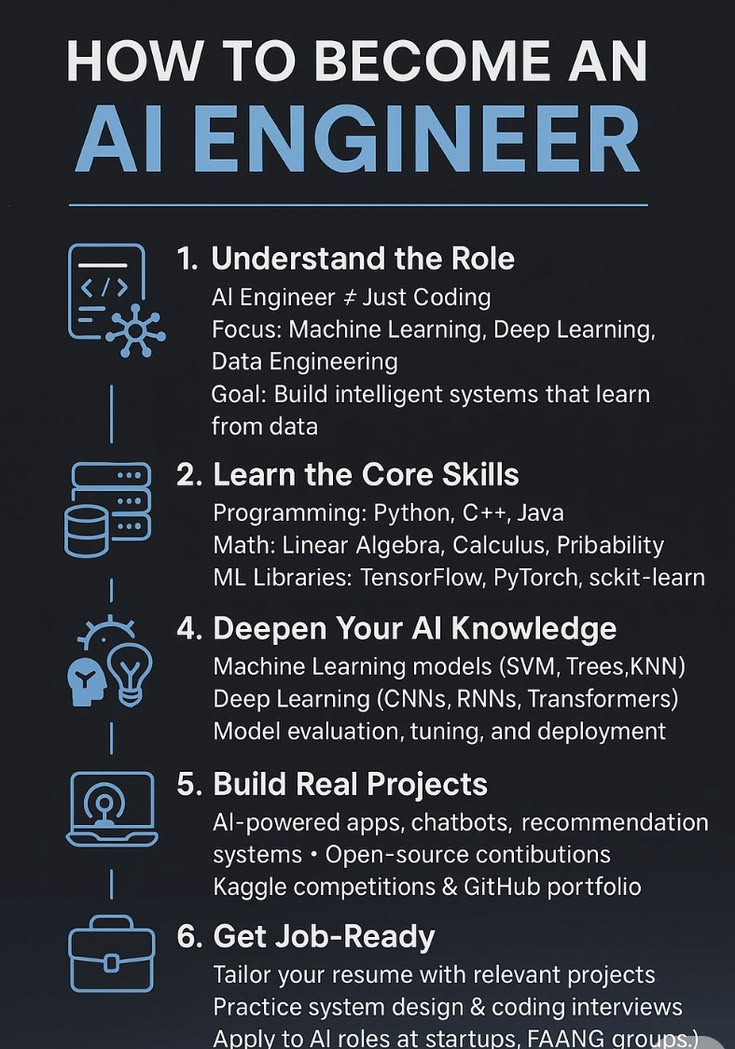

How Can You Become an AI Engineer
Artificial intelligence is becoming an important part of modern technology. Businesses, governments, research organizations, and technology companies use AI for everything from analyzing data and automating tasks to developing intelligent applications and improving decision-making.
As the use of AI continues to expand, the demand for professionals who can design, build, test, and maintain AI systems is also growing. One of the careers attracting attention is AI engineering.
Becoming an AI engineer requires a combination of technical knowledge, programming skills, mathematics, problem-solving ability, and practical experience. The good news is that you do not have to learn everything at once. You can build your skills gradually and develop your career step by step.
What Does an AI Engineer Do?
An AI engineer develops software systems that use artificial intelligence and machine learning techniques.
Depending on the job, an AI engineer may work on recommendation systems, computer vision applications, natural language processing, predictive models, intelligent automation, or AI-powered software products.
Typical responsibilities can include preparing data, developing machine learning models, testing systems, improving model performance, deploying AI applications, and monitoring them after deployment.
AI engineering can involve several different areas, so the exact responsibilities vary between companies and roles.
1. Learn the Fundamentals of Programming
Programming is one of the most important skills for an AI engineer.
Python is particularly useful because it is widely used in data science, machine learning, and AI development. Beginners can start by learning basic programming concepts such as variables, functions, loops, conditions, lists, dictionaries, and object-oriented programming.
You do not need to become an expert immediately. The goal is to develop enough programming knowledge to understand how software works and eventually build your own projects.
As your skills improve, you can learn additional technologies and programming concepts that are relevant to the type of AI engineering you want to pursue.
2. Build a Strong Mathematics Foundation
Mathematics plays an important role in understanding machine learning.
Important areas include statistics, probability, linear algebra, and calculus.
For example, linear algebra is useful for understanding vectors and matrices, which are commonly used in machine learning. Statistics and probability help engineers understand data, uncertainty, and model performance.
You do not necessarily need advanced mathematics before beginning your AI journey. Start with the fundamentals and gradually learn the mathematics behind the models you use.
Understanding why a model works is more valuable than simply knowing which library command to run.
3. Learn Data Structures and Algorithms
AI engineers also benefit from understanding data structures and algorithms.
Data structures provide ways to organize information efficiently, while algorithms provide methods for solving problems.
Learning these concepts can improve your programming ability and help you understand how to build efficient software.
Practice solving programming problems regularly. Start with simple challenges and gradually move toward more complex problems.
4. Understand Machine Learning
Machine learning is a major part of modern AI engineering.
You should understand important concepts such as supervised learning, unsupervised learning, classification, regression, clustering, training data, testing data, features, model evaluation, and overfitting.
You should also learn how machine learning models are trained and evaluated.
Instead of memorizing definitions, try building small projects. Practical experience can help you understand how different concepts work together.
5. Learn Popular AI and Machine Learning Tools
After learning the fundamentals, become familiar with commonly used tools and frameworks.
Python libraries such as NumPy and pandas are useful for working with data. Visualization tools can help you understand datasets and model results.
Machine learning frameworks such as scikit-learn, PyTorch, and TensorFlow can help you build and experiment with models.
You do not need to master every tool. Focus on understanding the fundamentals and become comfortable with the tools that are most relevant to your chosen area.
6. Explore Deep Learning
Deep learning is a specialized area of machine learning based on neural networks with multiple layers.
It is widely used in areas such as image recognition, speech processing, natural language processing, and other complex AI applications.
Once you understand basic machine learning, you can begin learning about neural networks, activation functions, loss functions, optimization, and model training.
Frameworks such as PyTorch and TensorFlow can then help you implement deep learning models.
7. Choose an AI Specialization
AI is a broad field. As you gain experience, consider choosing an area that interests you.
Possible specializations include:
- Natural language processing
- Computer vision
- Robotics
- Generative AI
- Machine learning engineering
- Speech and audio AI
- Recommendation systems
- AI for cybersecurity
- AI for healthcare
- Autonomous systems
You do not have to choose a specialization immediately. Exploring different areas can help you discover which type of work you enjoy.
8. Build Real AI Projects
Projects are one of the best ways to develop practical skills.
Instead of only watching tutorials, create applications that solve real problems.
For example, you could build a simple image classification system, a recommendation application, a text classification model, or a chatbot.
Start with manageable projects and gradually increase their complexity.
Each project gives you an opportunity to practice programming, data preparation, model development, testing, and documentation.
9. Create an AI Portfolio
A portfolio allows potential employers to see what you can actually build.
Include several projects that demonstrate different skills. For each project, explain the problem you were trying to solve, the technology you used, how the system works, and what you learned.
Your portfolio does not need dozens of projects. A smaller collection of well-documented projects can demonstrate your abilities effectively.
You can also include your code, project documentation, demonstrations, and explanations of important technical decisions.
10. Learn How AI Systems Are Deployed
Building an AI model is only part of becoming an AI engineer.
AI engineers often need to understand how models are integrated into applications and deployed for users.
Learning basic concepts related to APIs, cloud computing, databases, containers, version control, and software deployment can therefore be valuable.
Tools such as Git can help you manage your code and collaborate with other developers.
Understanding the software engineering side of AI can help you move from experimental models toward useful applications.
11. Learn About Generative AI
Generative AI has become an important area of artificial intelligence.
You can learn how systems generate text, images, audio, code, and other forms of content.
Important concepts include large language models, embeddings, vector databases, retrieval-augmented generation, model evaluation, and AI application development.
You should also learn about the limitations of generative AI, including inaccurate outputs, bias, security risks, and privacy concerns.
12. Practice Problem-Solving
AI engineering is not simply about knowing programming languages or machine learning frameworks.
Engineers need to identify problems, evaluate possible solutions, test ideas, and improve systems.
Develop your problem-solving skills by working on increasingly challenging projects.
When something does not work, investigate why instead of immediately looking for a solution. Debugging and experimentation are important parts of becoming a stronger engineer.
13. Consider Formal Education
A university degree in computer science, software engineering, mathematics, statistics, data science, or a related field can provide a strong foundation for an AI career.
However, education paths vary. Some people develop AI skills through online courses, professional training, personal projects, internships, and work experience.
The most appropriate path depends on your career goals, available resources, and existing experience.
14. Keep Learning
AI is developing quickly, which means AI engineers need to continue learning.
New models, frameworks, research papers, development tools, and engineering practices appear regularly.
Follow reputable technical resources, read documentation, experiment with new technologies, and work on projects that challenge your existing knowledge.
Continuous learning can help you keep your skills relevant.
15. Prepare for AI Engineering Jobs
When you are ready to apply for jobs, prepare a resume that highlights relevant technical skills and projects.
Practice explaining your projects clearly. Employers may ask about programming, machine learning concepts, system design, data processing, and how you solved technical problems.
Internships, junior engineering roles, research opportunities, and freelance projects can also help you gain practical experience.