
What Skills Will Employers Need in the Future?
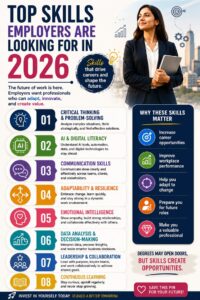
The workplace is changing as technology, artificial intelligence, automation, and digital tools become increasingly important. Employers are looking for workers who can adapt to new technologies while continuing to demonstrate strong communication, problem-solving, and professional skills.
For students, job seekers, and working professionals, understanding which skills may become more important can help with career planning. While no one can predict exactly what every employer will require in the future, several skills are already becoming increasingly relevant across many industries.
The future of work is unlikely to depend on one specific skill. Instead, workers may need a combination of technical knowledge, human abilities, industry expertise, and a willingness to continue learning.
1. Artificial Intelligence Skills
AI is becoming part of many workplace processes.
Employees may use AI for research, writing, data analysis, customer service, software development, marketing, and automation.
Workers do not necessarily need to become AI engineers. However, basic AI literacy can help employees understand how to use AI tools effectively and responsibly.
Depending on the profession, employers may also look for more advanced skills such as machine learning, AI development, automation, data science, or AI system management.
2. Digital Literacy
Digital literacy will remain important as businesses rely increasingly on software and online systems.
Workers should be comfortable learning new applications, managing digital information, using collaboration platforms, and understanding basic digital security.
The specific software used by companies will continue to change, so the ability to learn new digital tools may be more important than mastering one particular application.
3. Data Analysis
Organizations generate large amounts of data.
Employers need workers who can understand information, identify patterns, interpret results, and use data to support decisions.
Basic data skills may include spreadsheets, data visualization, statistics, and analytical thinking.
Some careers may require more advanced knowledge of SQL, Python, databases, or machine learning.
Even workers in non-technical roles can benefit from understanding basic data.
4. Critical Thinking
As AI becomes more capable of producing information, critical thinking becomes increasingly important.
Employees need to evaluate information, identify errors, question assumptions, compare alternatives, and make informed decisions.
AI can provide suggestions, but employees still need to determine whether those suggestions are appropriate.
Critical thinking can therefore help workers use technology without becoming overly dependent on it.
5. Problem-Solving
Employers need people who can identify problems and develop practical solutions.
Problem-solving involves understanding the cause of an issue, considering possible solutions, testing ideas, and improving results.
AI may assist with parts of this process, but workers still need to understand the business or customer problem they are trying to solve.
6. Communication
Strong communication will remain important in almost every profession.
Workers need to communicate clearly through emails, reports, presentations, meetings, and conversations.
As workplaces become more technology-driven, employees may also need to explain technical information to people who do not have technical backgrounds.
Clear communication can help teams collaborate and make better use of technology.
7. Adaptability
Technology can change quickly.
Employees may be asked to learn new software, adjust workflows, or take on new responsibilities.
Adaptability means being willing to learn, adjust, and improve when circumstances change.
Workers who are comfortable learning new skills can be better prepared for changing workplace requirements.
8. Creativity
Creativity is another skill that can complement AI.
AI can generate ideas, images, text, and other forms of content, but people still need to determine what is useful and appropriate.
Creative workers can use AI as a tool for brainstorming while applying their own judgment and understanding of the audience.
Creativity can also help employees find new solutions to business problems.
9. Collaboration
Modern workplaces often depend on teamwork.
Employees may work with colleagues from different departments, locations, cultures, and professional backgrounds.
The ability to share ideas, listen to others, resolve disagreements, and contribute to group projects can remain valuable even as AI becomes more common.
10. Emotional Intelligence
Understanding people is an important part of many careers.
Emotional intelligence includes skills such as self-awareness, empathy, communication, relationship management, and understanding other people’s perspectives.
These abilities can be particularly important in leadership, customer service, healthcare, education, management, and teamwork.
Technology may support these professions, but human relationships remain central to many workplace activities.
11. Leadership
Future workplaces will continue to need people who can guide teams and make decisions.
Leadership involves more than giving instructions.
Good leaders need to communicate goals, support employees, manage challenges, make decisions, and help teams adapt to change.
As AI becomes part of workplace decision-making, leaders may also need to understand the opportunities and limitations of the technology.
12. Cybersecurity Awareness
As organizations become more dependent on digital systems, cybersecurity becomes increasingly important.
Not every employee needs to become a cybersecurity professional, but workers should understand basic security practices.
These may include protecting passwords, recognizing suspicious messages, handling sensitive information carefully, and following company security policies.
Technical professionals may need much deeper cybersecurity knowledge.
13. Automation Skills
Automation can help organizations improve efficiency.
Workers who understand how to identify repetitive tasks and design or use automated workflows may be valuable in many industries.
Automation skills can range from simple no-code workflows to advanced software development and robotic process automation.
Understanding where automation can add value can help workers contribute to workplace improvements.
14. Industry-Specific Expertise
Technology skills alone are not enough.
Employers still need people who understand specific industries and professional environments.
For example, an AI system may assist with financial analysis, but finance professionals still need to understand financial principles.
Similarly, AI may support marketing work, but marketers need to understand customers, branding, communication, and business strategy.
Combining AI skills with industry knowledge can provide a useful professional foundation.
15. Continuous Learning
One of the most important future skills may be the ability to keep learning.
Technology is unlikely to stop changing.
Workers may need to regularly update their knowledge through courses, professional development, practical projects, workshops, and independent study.
Continuous learning does not mean constantly chasing every new technology.
Instead, workers should focus on developments that are relevant to their careers.
16. Research Skills
Employees often need to find reliable information quickly.
Research skills involve knowing what questions to ask, where to look for information, how to evaluate sources, and how to organize findings.
AI can help with parts of the research process, but workers still need to verify important information and distinguish reliable sources from inaccurate content.
17. Professional Judgment
As AI becomes more common, human judgment remains important.
Employees may need to decide whether an AI-generated recommendation makes sense, whether information is reliable, or whether an automated process should be changed.
Professional judgment comes from knowledge, experience, critical thinking, and understanding the context of a situation.
18. Time Management
Technology can help workers become more productive, but employees still need to manage their time effectively.
Prioritizing tasks, meeting deadlines, organizing projects, and avoiding unnecessary distractions remain important professional skills.
AI tools can help with planning, but workers should remain responsible for their schedules and commitments.
19. Ethical and Responsible Technology Use
Employers may increasingly value workers who understand responsible technology use.
Employees should understand issues involving privacy, security, bias, intellectual property, misinformation, and appropriate use of AI.
Responsible technology use helps protect organizations, customers, employees, and business information.
How Can You Prepare for Future Skills?
You do not need to learn all of these skills at once.
Start by identifying the career or industry you are interested in.
Then determine which technical and professional skills are most relevant.
For example, a future software developer may focus on programming, AI-assisted development, data structures, and cybersecurity.
A marketer may focus on AI tools, analytics, communication, content strategy, and customer research.
A business professional may focus on data literacy, automation, problem-solving, and AI applications.
Build practical projects whenever possible. Projects can help you turn theoretical knowledge into experience.
Final Thoughts
The future workplace is likely to require a combination of technology skills and human abilities.
Artificial intelligence, data analysis, automation, digital literacy, and cybersecurity awareness can help workers navigate increasingly digital workplaces. At the same time, critical thinking, communication, creativity, collaboration, leadership, adaptability, and problem-solving remain important.
Rather than trying to predict one perfect list of future skills, workers can focus on becoming adaptable professionals who are comfortable learning new technologies and applying them to real problems.
The most useful preparation is to keep developing both your technical skills and your human skills. As technology changes, the ability to learn, adapt, communicate, and solve problems can help you continue building your career.