
Can AI Create More Jobs Than It Replaces?
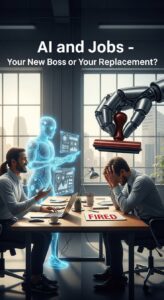
Artificial intelligence is changing the world of work. Businesses are using AI to automate repetitive tasks, analyze information, create content, support customers, develop software, and improve business processes. As these technologies become more capable, an important question is being asked by workers, students, employers, and job seekers: Can AI create more jobs than it replaces?
There is no certain answer because the long-term effects of AI will depend on how quickly organizations adopt the technology, how workers adapt, what new industries develop, and how businesses choose to use AI.
However, current research suggests that AI can both create and displace employment. The impact is likely to differ significantly between occupations, industries, countries, and skill levels.
AI Can Replace Some Tasks
One of the clearest effects of AI is its ability to automate certain tasks.
AI systems can perform activities such as generating routine text, processing information, answering common customer questions, analyzing large datasets, and assisting with repetitive administrative work.
When a company automates a task, it may need fewer employees to perform that particular activity. In some cases, this can reduce demand for certain roles.
The International Labour Organization (ILO) estimates that approximately one in four workers worldwide are in occupations with some exposure to generative AI. However, the ILO also finds that transformation of jobs is generally more likely than complete replacement because most occupations still contain tasks that require human involvement.
This distinction is important. AI may change what a worker does without eliminating the entire occupation.
AI Can Create New Jobs
At the same time, new technologies can create demand for new types of work.
AI development requires people with skills in areas such as software engineering, machine learning, data science, cybersecurity, AI operations, and system management.
Businesses also need professionals who can integrate AI into existing operations, train employees, evaluate AI systems, manage data, and establish responsible-use policies.
The World Economic Forum’s Future of Jobs Report 2025 projects that, across major global labour-market trends, approximately 170 million jobs could be created and 92 million could be displaced by 2030, resulting in a projected net increase of 78 million jobs. These figures cover multiple trends—not AI alone—so they should not be interpreted as an AI-only forecast.
Technology-related roles, including AI and machine-learning specialists, are among the occupations expected to grow rapidly in percentage terms.
AI Can Transform Existing Jobs
Job creation and job replacement are not the only possibilities.
AI can transform existing occupations by changing the tasks employees perform.
For example, a marketing professional might use AI to analyze customer information or generate an initial content draft. The marketer may then spend more time developing strategy, reviewing content, understanding customers, and making decisions.
Similarly, a software developer might use AI to assist with coding while spending more time reviewing solutions, testing applications, designing systems, and solving complex problems.
The ILO’s research indicates that generative AI is more likely to augment many occupations than completely automate them.
New AI-Related Careers Could Emerge
As AI becomes more widely used, businesses may require new combinations of technical and professional skills.
Potential areas of employment include:
- AI engineering
- Machine learning
- Data science
- AI product development
- AI implementation
- AI operations
- Automation
- AI security
- Data management
- AI governance
- AI training and education
- AI-assisted marketing
- AI consulting
Some of these are entirely new or rapidly developing areas, while others represent existing occupations that are adapting to AI.
The exact number of future AI-related jobs is difficult to predict because technology and business practices continue to evolve.
Human Skills Can Become More Important
AI can perform many tasks quickly, but workplaces still require human judgment.
Skills such as communication, leadership, creativity, critical thinking, collaboration, negotiation, and problem-solving can remain important when AI is introduced.
For example, an AI system may generate several possible solutions to a business problem. A human employee still needs to determine which solution makes sense for the organization.
This means the future of work may involve a combination of technical and human capabilities rather than a simple competition between humans and machines.
AI Can Increase Productivity
Another way AI may affect employment is through productivity.
If employees can complete certain tasks faster, companies may be able to produce more goods and services or develop new products.
In some cases, increased productivity can contribute to business expansion, which may create additional demand for workers.
However, productivity gains do not automatically translate into more employment. The effect depends on how businesses respond to increased efficiency, consumer demand, investment, competition, and other economic factors.
Recent ILO research reviewing empirical evidence finds that productivity gains from generative AI are real in some settings but uneven, while large-scale job displacement has so far remained limited.
Some Workers May Face Greater Disruption
The effects of AI will not be evenly distributed.
Jobs involving large amounts of routine, predictable, or digital tasks may have greater exposure to generative AI.
The ILO’s 2025 analysis identifies clerical occupations as having particularly high exposure, while also noting that exposure does not automatically mean a job will disappear.
Workers in highly exposed occupations may need to develop new skills or move toward responsibilities that complement AI.
This can make education, training, and career development important parts of the transition.
AI May Create Opportunities for Small Businesses
AI can also make certain capabilities more accessible to individuals and small businesses.
A small company may use AI-assisted tools for marketing, customer support, data analysis, software development, research, or administrative work.
This can allow small teams to perform activities that previously required larger departments or outside services.
At the same time, greater access to AI can increase competition because more businesses may be able to produce similar services.
Skills Will Matter More
As AI changes workplace tasks, workers may need to continually update their skills.
Useful skills can include:
- AI literacy
- Data analysis
- Digital skills
- Automation
- Critical thinking
- Communication
- Problem-solving
- Creativity
- Industry-specific expertise
Technical workers may need programming and machine-learning knowledge, while professionals in other fields may benefit from learning how AI applies to their particular industry.
The World Economic Forum reports that technological skills are expected to grow in importance alongside human skills such as analytical thinking and collaboration.
Will AI Create More Jobs Than It Replaces?
The evidence does not support a simple universal answer.
Some jobs will likely be reduced or significantly changed as AI becomes more capable. Other jobs will be created as businesses develop new technologies, products, services, and industries.
Current forecasts provide evidence of substantial job creation alongside job displacement, but forecasts are not guarantees.
The ILO’s research emphasizes that transformation rather than complete replacement is likely to be the dominant effect for many occupations.
Therefore, the more useful question may not be whether AI will simply create more jobs than it replaces. It may be how many existing jobs will change, which new roles will emerge, which workers will benefit, and whether people have opportunities to develop the skills required for changing jobs.
How Can Workers Prepare?
Workers can prepare by learning how AI applies to their profession.
Start by identifying tasks that AI can assist with and learning appropriate tools. Then develop skills that allow you to evaluate AI outputs and solve problems that require human judgment.
Building a combination of AI knowledge and professional expertise can help workers adapt as workplace requirements change.
Students and job seekers can also create projects, learn digital skills, develop portfolios, and explore emerging career areas.
Final Thoughts
AI has the potential to both eliminate some tasks and create new opportunities. Current research suggests that many jobs are more likely to be transformed than completely replaced, while new occupations and industries can emerge around AI and other technological changes.
The overall effect will depend on many factors, including business investment, technology development, consumer demand, education, worker training, and how organizations choose to implement AI.
For workers, the most practical response is to focus on adaptability. Learning how AI works, developing relevant skills, and combining technology with human judgment can help people participate in an evolving labour market.
AI may not simply create a world with fewer jobs or more jobs. It is more likely to create a different world of work, where some roles decline, others grow, and many existing jobs change significantly.