
How Can AI Help You Discover New Career Opportunities?

Choosing a career path can be challenging. Many people know what they are good at but are unsure how their skills could translate into different careers. Others may feel stuck in their current profession and want to explore new opportunities but do not know where to begin.
Artificial intelligence can become a useful tool for career exploration. AI can help people identify possible career paths, compare skills with job requirements, discover emerging roles, explore industries, and create learning plans.
AI cannot determine the perfect career for you, and its suggestions should not replace personal research or professional advice. However, when used thoughtfully, it can help you explore possibilities that you may not have considered before.
1. Start With Your Existing Skills
One of the best ways to discover new career opportunities is to understand the skills you already have.
AI can help you organize your skills into categories such as technical skills, communication skills, leadership abilities, creative skills, analytical abilities, and transferable skills.
For example, someone with experience in customer service may already have communication, problem-solving, organization, and relationship-building skills.
Those skills could potentially be useful in areas such as sales, account management, customer success, recruitment, or business development.
AI can help you see connections between your existing experience and different career options.
2. Explore Transferable Skills
Transferable skills are abilities that can be useful across different jobs and industries.
Examples include:
- Communication
- Teamwork
- Leadership
- Time management
- Problem-solving
- Research
- Organization
- Critical thinking
- Creativity
- Data analysis
AI can help you identify careers where these skills are commonly used.
This can be particularly useful if you want to change careers without starting completely from zero.
3. Discover Alternative Job Titles
Sometimes people struggle to find opportunities because they search for only one job title.
For example, someone interested in writing might search only for “writer.” However, related positions could include content specialist, copywriter, communications assistant, content strategist, technical writer, or editorial assistant.
AI can help generate related job titles based on your skills and experience.
This can expand your job search and help you discover positions you may not have known existed.
4. Explore Emerging Career Fields
Technology is creating new roles and changing existing ones.
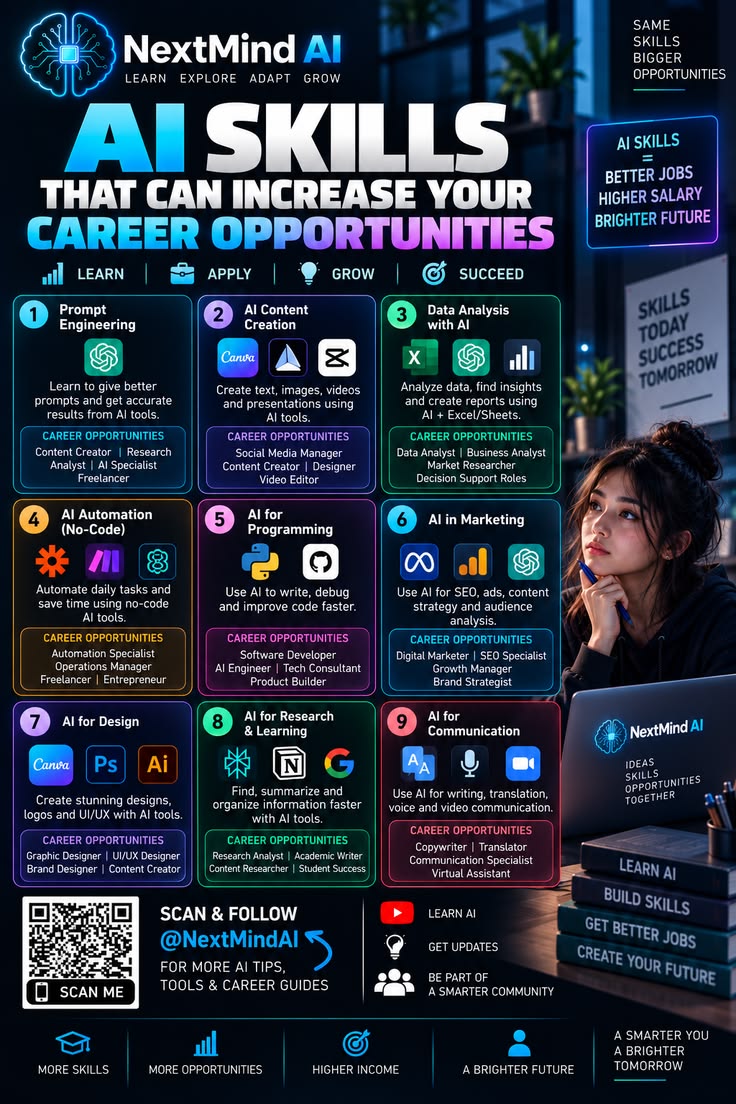
AI can help you research emerging career areas related to artificial intelligence, automation, data, cybersecurity, digital products, and other technologies.
For example, people interested in AI may explore roles involving AI implementation, machine learning, data analysis, AI product development, AI operations, or AI-supported business processes.
However, because career trends can change quickly, verify information about new occupations using current job listings and reliable industry sources.
5. Compare Your Skills With Job Requirements
Another useful application of AI is comparing your current skills with the requirements of a potential career.
Suppose you are interested in becoming a data analyst. AI can help you identify common requirements such as spreadsheet skills, SQL, statistics, data visualization, and analytical thinking.
You can then compare those requirements with your existing abilities.
This can show you which skills you already possess and which ones you may need to develop.
6. Create a Career Skill Gap Analysis
A skill gap analysis compares what you currently know with what you need for a particular career.
AI can help organize this information into a simple plan.
For example:
Current skills: Communication, Excel, customer service
Target career: Data analyst
Potential skills to develop: SQL, statistics, data visualization, data-cleaning techniques
This type of analysis can turn a vague career goal into a more practical learning plan.
7. Find Careers That Match Your Interests
Skills are important, but interests also matter.
You can use AI to explore career options based on subjects and activities you enjoy.
For example, someone interested in technology, writing, and communication could explore areas such as technical writing, technology marketing, product education, or content creation for technology companies.
AI can generate possibilities, but you should research each career independently before making major decisions.
8. Explore Different Industries
Your skills may be useful in more industries than you realize.
For example, someone with project management experience might find opportunities in technology, construction, healthcare, finance, education, marketing, or nonprofit organizations.
AI can help you brainstorm industries where your existing skills could be relevant.
This can be especially useful when a person wants a career change but does not want to completely start over.
9. Research Remote Career Opportunities
AI can also help people explore careers that are compatible with remote work.
Depending on your skills, possible areas may include software development, digital marketing, writing, graphic design, customer support, data analysis, project coordination, and online education.
However, remote availability varies by employer and location.
Always check actual job listings to determine whether a particular role is available remotely and whether you meet the employer’s requirements.
10. Explore Freelance Careers
A career does not always have to follow a traditional full-time employment path.
AI can help you identify skills that could potentially be offered as freelance services.
For example, someone with writing skills might explore content writing or editing. Someone with design experience could investigate freelance graphic design. A person with administrative experience could explore virtual assistance.
AI can help you brainstorm service ideas, potential client types, and skills to develop.
However, successful freelancing requires more than technical ability. Finding clients, building trust, meeting deadlines, and delivering quality work are also important.
11. Build a Learning Roadmap
Once you discover a career that interests you, AI can help organize a learning roadmap.
For example, you could ask AI to divide your learning into stages:
Stage 1: Learn the fundamentals.
Stage 2: Practice with small projects.
Stage 3: Develop intermediate skills.
Stage 4: Build a portfolio.
Stage 5: Apply for internships, freelance projects, or entry-level roles.
This can make a large career goal feel more manageable.
12. Discover Career Paths You May Not Have Considered
AI can be useful for brainstorming because it can connect skills from different areas.
Someone with a background in finance and an interest in technology, for example, might explore financial technology, data analysis, risk technology, or AI-related financial applications.
These combinations can create interesting career possibilities.
However, treat AI suggestions as ideas to investigate rather than guaranteed career recommendations.
13. Prepare Questions for Career Research
AI can also help you become a better researcher.
For each career you are considering, you can create questions such as:
- What does this job involve?
- What skills are commonly required?
- What qualifications are useful?
- What does a typical workday look like?
- What industries hire people for this role?
- What entry-level opportunities exist?
- Which skills should I learn first?
You can then research these questions using reliable sources, professional networks, job listings, and educational resources.
14. Create a Career Experiment
You do not always need to make a permanent career decision immediately.
Instead, try a small experiment.
If you are interested in data analysis, complete a beginner project. If you are interested in marketing, create a sample campaign. If you are interested in programming, build a simple application.
AI can help you plan these projects and explain unfamiliar concepts.
Practical experiments can help you discover whether you actually enjoy a type of work.
15. Keep Your Career Research Current
Career opportunities change over time.
New technologies can create new roles, while existing positions may change their responsibilities.
Use AI as one source of information, but regularly check current job postings, professional organizations, training providers, and industry publications.
This can help you distinguish between interesting possibilities and careers with actual opportunities.
Final Thoughts
AI can be a useful career exploration tool. It can help you identify transferable skills, discover alternative job titles, explore industries, investigate emerging roles, analyze skill gaps, and create learning plans.
However, AI should not make career decisions for you.
Your interests, abilities, financial goals, circumstances, values, and long-term plans all matter when choosing a career direction.
Use AI to expand your options and ask better questions, then verify those possibilities through real-world research and practical experience.
The most valuable career discovery process combines AI assistance with human curiosity, learning, experimentation, and informed decision-making.