
Can AI Help You Earn More in Your Career?
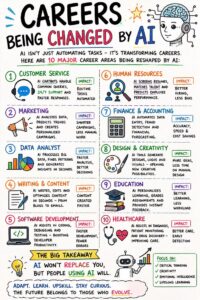
Artificial intelligence is changing the way people work across many industries. From marketing and finance to software development, education, customer service, and business operations, AI tools are helping professionals complete tasks faster and work with large amounts of information more efficiently.
This has created an important question for workers and job seekers: Can AI help you earn more in your career?
The answer depends on how you use it. Simply knowing how to access an AI tool does not automatically lead to a higher income. However, learning how to use AI effectively, combining it with valuable professional skills, and using it to solve real business problems can potentially create opportunities for career growth and additional income.
AI Can Help You Become More Productive
One of the most direct ways AI can support your career is by improving productivity.
Many professionals spend hours on repetitive activities such as writing routine emails, organizing information, summarizing documents, creating reports, researching topics, or preparing presentations.
AI tools can assist with some of these tasks, allowing workers to spend more time on activities that require human judgment, creativity, and decision-making.
For example, a marketing professional could use AI to brainstorm campaign ideas and organize research before developing the final strategy. A salesperson could use AI to summarize customer information before a meeting.
Saving time does not automatically increase your salary, but greater productivity can make your work more valuable when combined with strong professional performance.
AI Skills Can Strengthen Your Resume
As businesses adopt AI technologies, employees who understand how to use these tools may have an additional skill to demonstrate to employers.
Instead of simply listing “AI” on a resume, professionals can show how they have applied AI to real tasks.
For example, a candidate might explain that they used AI-assisted analysis to organize a large dataset, automated part of a reporting process, or developed an AI-supported customer service workflow.
Specific examples are usually more meaningful than simply claiming to be familiar with AI.
AI Can Help You Develop New Skills
AI can also act as a learning assistant.
Suppose you want to learn data analysis, programming, digital marketing, or another professional skill. AI can help explain concepts, create practice exercises, review your work, and provide examples.
For beginners, this can make learning more accessible.
However, AI should support learning rather than replace it. You still need to understand the concepts yourself and verify important information.
Developing valuable skills can increase the range of jobs and projects you are qualified to pursue.
AI Can Support Freelancing
Freelancers can use AI to improve their workflows and potentially take on a wider range of projects.
For example, a freelance writer might use AI for brainstorming and research organization. A graphic designer might use AI-assisted tools during the creative process. A virtual assistant might use automation to organize repetitive administrative tasks.
The freelancer remains responsible for the quality of the final work.
AI can help reduce the time required for certain tasks, but clients generally pay for useful results, expertise, reliability, and quality—not simply for the use of an AI tool.
AI Can Help Entrepreneurs
Business owners can also use AI to reduce certain costs and improve operations.
AI can assist with market research, customer communication, content planning, data analysis, administrative work, and other business activities.
For a small business owner, using AI effectively may make it possible to complete certain tasks without immediately hiring additional staff.
AI can also help entrepreneurs test ideas more quickly. For example, a business owner could use AI to brainstorm product concepts, analyze customer feedback, or develop an initial marketing plan.
The quality of the business idea and execution still matters far more than simply using AI.
AI Can Help You Move Into New Career Areas
Learning AI-related skills may open doors to career areas that are growing around artificial intelligence.
Potential areas include:
- AI engineering
- Data analysis
- Machine learning
- AI product development
- AI-assisted marketing
- Automation
- AI consulting
- AI content operations
- Technology support
- AI research
Not every AI-related career requires advanced programming. Some roles combine AI with existing professional knowledge.
For example, someone with a marketing background could focus on AI-powered marketing systems rather than becoming a machine-learning engineer.
Combining AI With Your Existing Skills
One of the most useful approaches is to combine AI with skills you already have.
Think of AI as an additional capability rather than your entire professional identity.
A teacher who learns AI can explore AI-assisted education tools. A financial professional can learn how AI supports data analysis. A marketer can learn AI-assisted campaign development. A designer can learn AI-supported creative workflows.
This combination can create a broader skill set.
The goal is not necessarily to become an expert in every area of AI. Instead, learn how AI can make your existing expertise more effective.
AI Can Help With Job Searching
AI can also support the job-search process.
Job seekers can use AI to improve resume wording, organize their experience, practice interview questions, identify potential skill gaps, and prepare for specific roles.
For example, someone applying for a marketing position could use AI to generate practice interview questions based on the responsibilities listed in a job description.
However, candidates should make sure that resumes and applications accurately represent their real experience. AI should help present your skills clearly rather than invent qualifications.
AI Can Help You Build a Personal Brand
Professionals can use AI to support their online presence.
AI can help brainstorm article topics, organize content calendars, draft social media ideas, and repurpose existing content.
Someone building a professional reputation online could use AI to develop a consistent publishing schedule.
However, personal branding works best when content reflects genuine knowledge and experience. Publishing large amounts of generic AI-generated material may not create the same value as sharing useful, original insights.
AI Does Not Guarantee a Higher Salary
It is important to understand that AI skills alone do not guarantee higher earnings.
Income depends on many factors, including industry, experience, location, qualifications, job responsibilities, market conditions, employer demand, and individual performance.
A person who learns an AI tool but cannot apply it effectively may not gain a significant career advantage.
The valuable combination is AI skills + professional expertise + problem-solving ability + measurable results.
How Can You Start Using AI for Career Growth?
If you want to use AI to support your career, start with your current work.
Identify repetitive tasks that take significant time. Then determine whether an AI tool can safely assist with them.
Next, learn AI tools that are relevant to your profession.
Build practical projects that demonstrate what you can do. Keep track of measurable improvements when possible, such as time saved, processes simplified, or improvements in workflow quality.
Finally, continue developing your core professional skills. AI changes quickly, but strong communication, critical thinking, creativity, adaptability, and industry knowledge remain important.
Final Thoughts
AI can potentially help people increase their career opportunities and earning potential, but it is not a shortcut to higher income.
The strongest approach is to learn how AI can complement your existing expertise. Use it to improve productivity, develop new skills, support freelance work, explore new career opportunities, and solve practical problems.
Professionals who understand both their field and the technology available to them can be better positioned to adapt as the workplace changes.
Rather than asking whether AI alone can make you earn more, a more useful question is: How can I use AI to become more valuable at the work I already do?
That mindset can turn AI from simply another technology into a practical tool for long-term career development.